Put the question on the form the customer is already filling in. That’s the whole method, and it’s worth doing because of what it saves you: no chasing, no awkward follow-up email, no folder of nice quotes you’re not sure you’re allowed to use. The yes arrives attached to the words, and you can publish the same afternoon.
The question, and where it sits on the form
The moment a customer finishes writing you a testimonial is the easiest moment they will ever have to say yes to publishing it. They’re pleased with the work, they’ve just spent two minutes describing it, and the question takes one click to answer.
Compare that with the alternative almost everyone ends up in. The words arrive in an email. Three weeks later you’re building a landing page, you find the quote, and now you have to write a message that begins “you might not remember this, but…” That message is ten minutes of work you keep postponing, and the ones never written are why good testimonials sit in inboxes doing nothing.
So the fix isn’t a better follow-up email. It’s not needing one. If you’re setting up a testimonial request from scratch, this is one field, and it’s the field that decides whether the rest of the form was worth filling in. Short, plain, and no fine print — the wording that works reads like a person asking, not a form demanding:
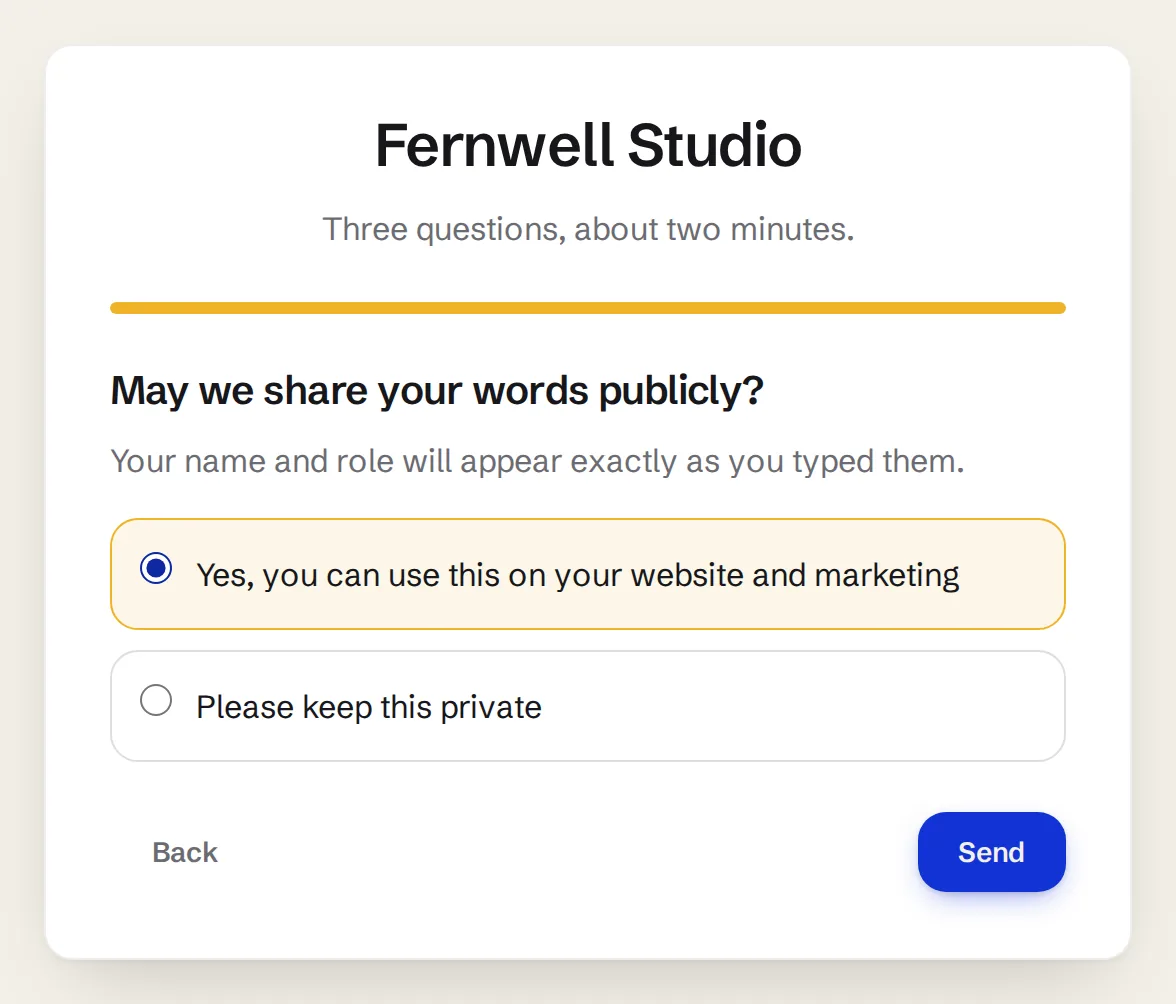
May we share your words publicly?

( ) Yes, you can use this on your website and marketing
( ) Please keep this private

Your name and role will appear exactly as you typed them.
Three things make that version work. It is specific about where the words go, so nobody is agreeing to something vague. It names what will be shown, which is the part people actually worry about. And it offers a real second option, which is what the next section is about.
Put it last, after the testimonial has been written. Asked first, it is a hurdle in front of the task. Asked last, it is a courtesy at the end of one, and the customer answering it has already decided they like you.
Two answers collect more than one
A yes-or-no question throws away your best material.
Plenty of people are glad to help you and still don’t want their name on your homepage. A customer at a company with a communications policy. Someone in a competitive niche. A beta user who likes the product but isn’t ready to be publicly attached to it. Asked “can we publish this?”, every one of them says no, and you record nothing at all.
Asked “public, or private?”, a lot of them pick private — and private is worth keeping. A quote you can’t put on your site is still a quote you can put in a proposal, a sales deck, a pitch, or an email to a prospect who is hesitating. Those land in front of someone already talking to you, which is a shorter road than persuading a stranger.
| What they choose | Where you can use it | What it’s worth |
|---|---|---|
| Public | Website, ads, social, case studies | Works on strangers, at scale |
| Private | Proposals, decks, sales calls, one-to-one email | Works on people already in conversation |
| Nothing recorded | Nowhere, safely | Nothing |
The bottom row is what a single checkbox produces every time someone hesitates. Two options is the difference between a soft no and an asset.
The answer has to live on the submission
Wherever you collect testimonials, the permission needs to end up on the entry itself, not in your memory or a spreadsheet somebody stopped updating. That is the practical difference between a permission question that helps you and one that only made your form longer.
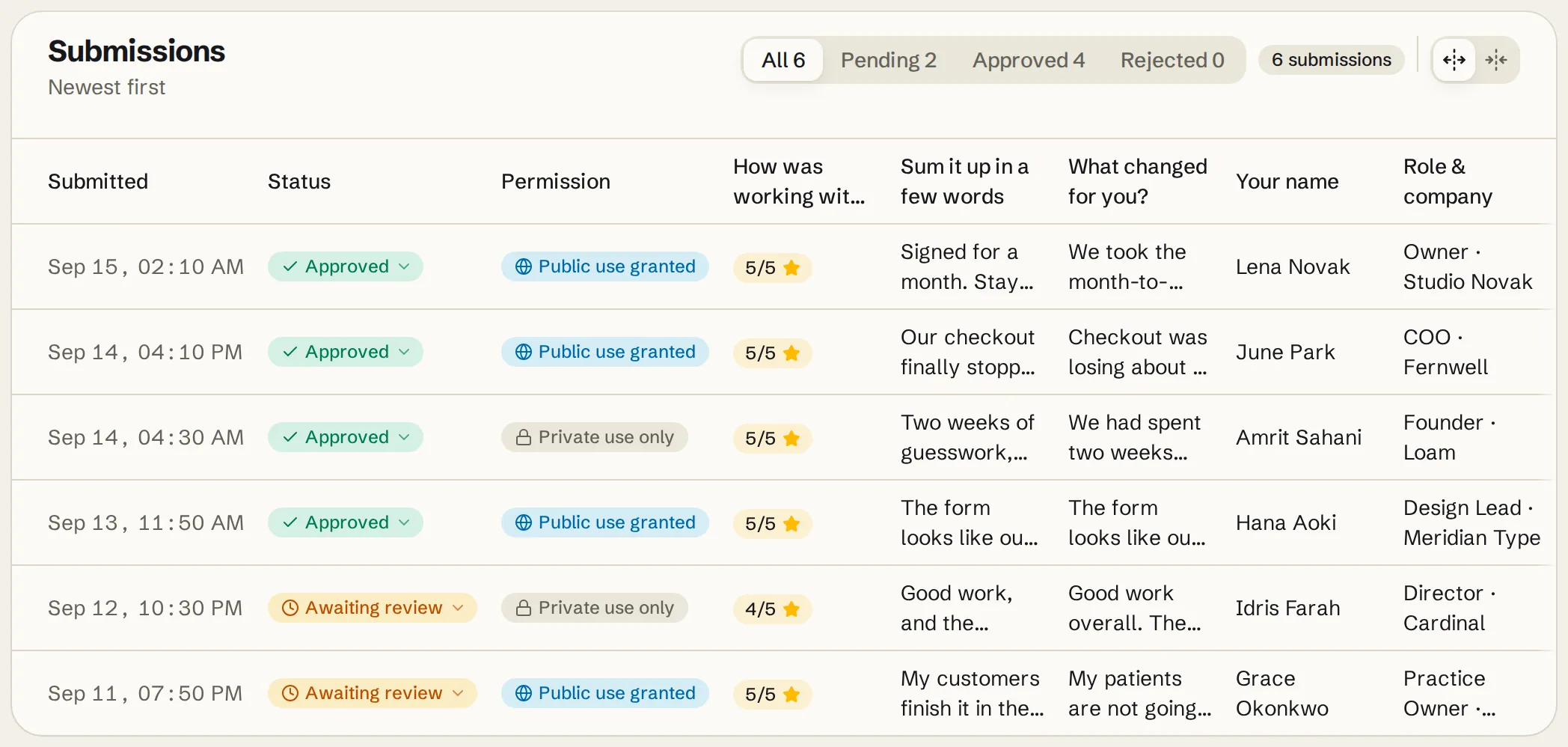
In Testymo the choice is part of the submission: each entry carries whether it was granted public use, private use, or was never asked, and a widget can be restricted to the public ones so a private quote cannot reach your site by accident. The stored response is what the customer typed, so what you approve is what they wrote. If you’re building a form elsewhere, the requirement is the same — the answer, stored per entry, filterable when you publish.
A yes given on a call is a real yes, and it is the one you will not be able to find in eight months. Follow the call with two lines confirming what you’ll use and where, and keep the reply. Better still, send the form link while the call is fresh and let the answer land where all the others are.
What a stored yes is worth six months later
Your testimonials don’t stay put. The one you collected for your homepage ends up on a pricing page, then in a deck, then in a LinkedIn post, then on a new site after a redesign. Each of those moves raises the same question — am I allowed to put this here? — and with a recorded answer it takes two seconds instead of an email thread. Teams that don’t record it either stop reusing their best quotes or reuse them and hope, and both of those cost you.
It is also what turns a takedown request into a two-minute job. A customer asks you to remove their words, you find the entry, you pull it from everywhere it appears, and you don’t make it a negotiation. That costs you one quote. What makes it cheap is knowing exactly which quotes came with which answer.
And it’s what lets you display testimonials confidently at the sizes that work. A hero quote with a full name and role is the strongest single thing on most pages, and nobody publishes one from a customer they’re unsure about.
Praise you already own, and praise you only borrowed
Most businesses are sitting on testimonials they haven’t asked about: a five-star review, a message that made your week, a line in a thank-you email.
Publish those and you skip a step you shouldn’t, and not only because of the person who wrote them. A review sits on someone else’s platform, under that platform’s rules about who may reuse it and how. Trustpilot’s brand guidelines are a fair example: review content in advertising is reserved for its paid plans, and every Trustpilot review you display has to carry Trustpilot’s name and logo. That is the difference between proof you own and proof you are borrowing — the same split that decides whether to chase a review or a testimonial in the first place.
Converting one into the other costs a single message, and it’s a message people almost always say yes to, because you are telling them they wrote something good.
Subject: Re: [their message]

This made my week, thank you.

Would you mind if we used it on our site? If you'd rather put it in your
own words, here's a short form instead — three questions, about two minutes:
[link]

Either way works, and "no" is a perfectly fine answer.
That’s the highest-yield message on this page, because the testimonial already exists and you’re only asking for the byline. More variants live in the testimonial request email templates, and the same message turns a review you don’t control into a quote you do.
Three asks worth more than a form field
Most website use doesn’t need a signed document, and treating every testimonial as if it does is how businesses end up with none. A clear recorded yes at collection time is proportionate for a quote on your own pages.
Three situations are worth more than a form field: paid advertising, anything printed, and a named case study that describes a customer’s business in detail. Those reach further, are harder to take back, and usually involve someone’s employer as well as the person. Send a short written agreement covering what you’ll use, where, and for how long. It’s a different conversation from a testimonial ask, so make it one rather than burying it in the form.
If you give something in return, say so beside the quote
A surprise thank-you after a testimonial arrives is a nice thing to do. A promised reward is a different object: it changes what the testimonial is evidence of. If you do promise one, say so plainly next to the quote — an incentive a reader discovers rather than reads is the kind of thing that sends them back to re-examine every other quote on the page, which is the failure mode behind testimonials that look fake.
Then permission becomes one more field alongside the questions that build the testimonial itself, which is exactly where it belongs: a two-second click at the end of a two-minute form, and the last time you have to think about it.